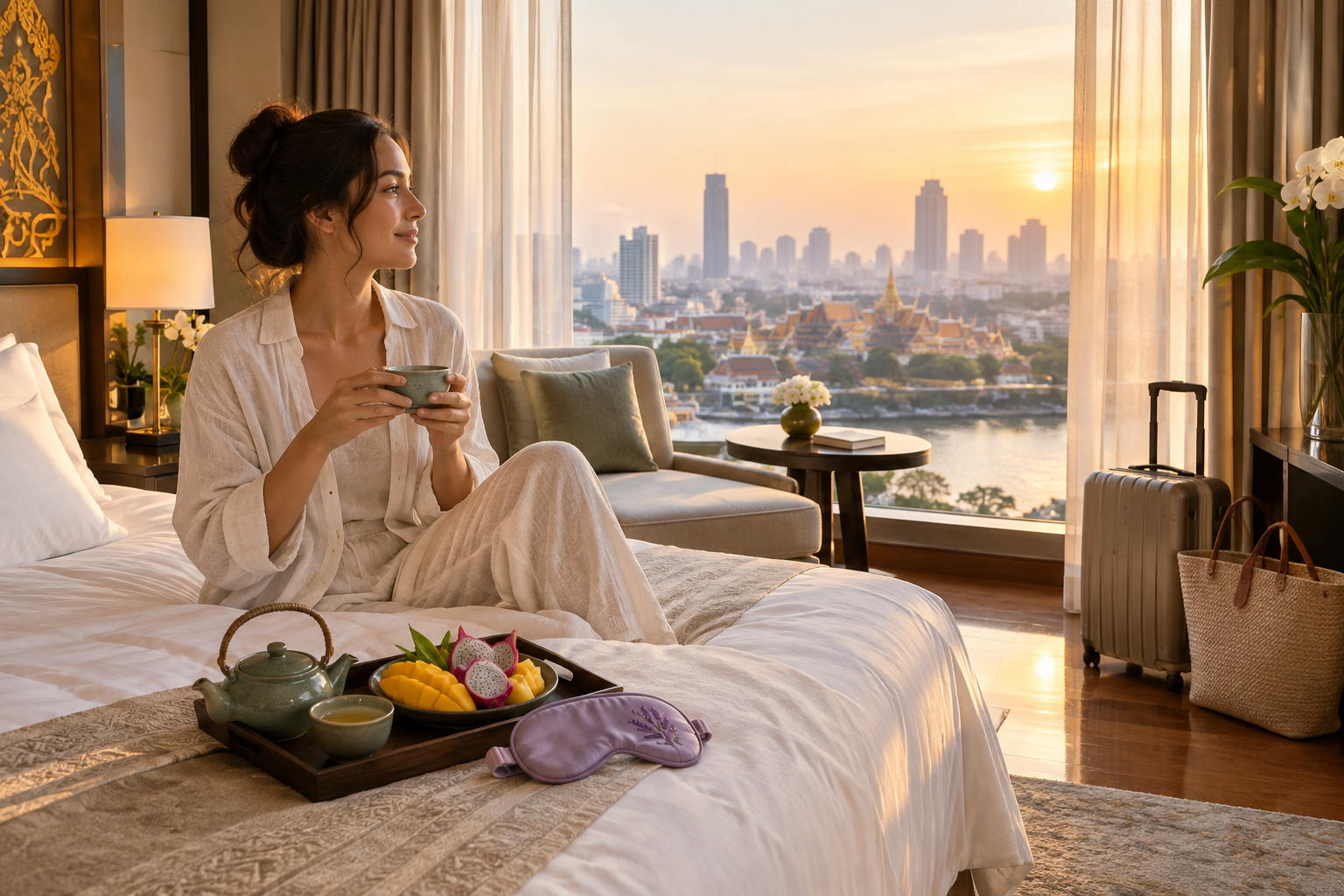

Jet Lag Recovery in Bangkok Starts the Moment You Land
Bangkok runs on Indochina Time, UTC+7. The single most effective thing you can do is behave as though you have always been in that time zone: eat at local meal times, go to bed at a local bedtime, and stop calculating what time it is at home. If you land in the morning, stay up until a normal local evening. If you land at night, skip the big dinner and get horizontal as soon as you reasonably can. Even broken sleep in a dark room on the first night does more good than a perfect nap at the wrong hour.The Biggest Lever in Jet Lag Recovery in Bangkok Is Light — Timed to Your Direction
 This is where most advice goes wrong. The common instruction to "get daylight as early as possible" is right for some arrivals and actively counterproductive for others.
Light does not simply wake you up. It shifts your body clock either earlier (a phase advance) or later (a phase delay), depending on when you receive it. Morning light advances the clock. Evening light delays it. Which one you want depends entirely on the direction you flew.
This is where most advice goes wrong. The common instruction to "get daylight as early as possible" is right for some arrivals and actively counterproductive for others.
Light does not simply wake you up. It shifts your body clock either earlier (a phase advance) or later (a phase delay), depending on when you receive it. Morning light advances the clock. Evening light delays it. Which one you want depends entirely on the direction you flew.
Flying east to Bangkok — from the UK, Europe, the Middle East or Africa. You need to advance your clock. Seek morning and midday light. Avoid bright light late in the evening.
Flying west to Bangkok — from Australia, New Zealand or the western Pacific. You need to delay your clock. Seek late afternoon and early evening light. Go easy on very early morning light for the first day or two.
Arriving from North America, where the shift approaches 12 hours or more, the directional rules lose their edge. Get outside during the local day, anchor firmly to local meal and sleep times, and don't overthink the hour.
Hydration Matters More in Bangkok Than at Home
Dehydration quietly undermines jet lag recovery in Bangkok. Cabin air is dry, long flights encourage coffee and alcohol, and then you step into tropical heat and humidity. Dehydration does not cause jet lag, but it reliably makes the symptoms feel worse — headaches, heaviness, poor concentration.- Sip steadily rather than drinking a litre at once
- One electrolyte or oral rehydration drink if you feel genuinely depleted after a flight over ten hours
- Keep alcohol minimal for the first 24 hours
- Use caffeine deliberately and early, not continuously
- Lean on water-rich food — fruit, soups, vegetables
Move gently, not ambitiously
Movement is the most underrated part of jet lag recovery in Bangkok. Lying in bed for hours leaves you stiff and groggy. A hard workout in Bangkok's heat, on no sleep and low fluids, leaves you worse. The useful middle ground is movement that improves circulation without taxing you.- A 20 to 40 minute easy walk after check-in
- Light stretching or gentle yoga, focusing on calves, hips, lower back, chest and neck
- A shaded swim if you are well hydrated
- Slow breathing with longer exhales, if you feel wired but exhausted
Massage and spa: go gentler than you think
Bangkok's spa culture is a genuine advantage for jet lag recovery in Bangkok, but not every treatment suits a body that landed four hours ago. For the first 24 hours, restorative beats intense.- Foot reflexology if your feet and lower legs are swollen
- Aroma oil massage for relaxation rather than deep work
- Head, neck and shoulder if you slept upright
- A gentle facial if cabin air has left your skin unhappy
Eat for stable energy
Meal timing is itself a body-clock signal, so eating on local time is part of jet lag recovery in Bangkok rather than just feeding you. The aim for the first 48 hours is steady energy and easy digestion, not dietary virtue.- Rice porridge or a light soup if your stomach feels unsettled
- Grilled fish or chicken with rice and vegetables for a grounding lunch
- Fruit with yogurt for a light breakfast
- Hydrating foods — watermelon, papaya, cucumber, broth-based dishes
Nap carefully, or not at all
A short nap can rescue a day. A long one can cost you a night. If you need one, keep it to 20 to 30 minutes, take it earlier rather than later, and set an alarm. Two or three hours in the afternoon usually means waking confused, eating at the wrong time, and lying awake at midnight. If you can get through to a normal local bedtime without napping, that is almost always the faster route.Make the room work for sleep
Bangkok is loud, and sleep is where jet lag recovery in Bangkok is finally won. Cool the room properly, close the curtains fully, and cut screen light before bed — particularly if you flew east, where evening light works directly against you. Earplugs or a white noise app earn their place if you are near a main road or a nightlife strip. A warm shower before bed helps. If recovery is the priority for your first nights, a quieter neighbourhood near green space will serve you better than the busiest entertainment districts. Ask for a room away from lifts and road frontage.Jet Lag Recovery in Bangkok: A Realistic First 48 Hours
Arrival morning. Clear the airport without rushing, get to the hotel, shower, eat something light and balanced. Arrival afternoon. A slow walk in daylight — timed to your direction of travel. A gentle massage, or quiet time in the shade. A 30-minute nap only if you truly need it. Arrival evening. Early dinner, minimal alcohol, low screen light, bed at a sensible local hour. Day two. One main attraction in the morning, a rest or spa treatment in the afternoon, a calm dinner. Save the long market circuits and late nights until your sleep has settled.How long does it take?
As a rough guide, the body re-adjusts at roughly one time zone per day after eastward travel and a little faster westward. From the UK or western Europe to Bangkok — six or seven zones, eastward — that means a genuine settling period of several days, not one good night's sleep. Most people feel broadly functional within two to three days if they manage light, sleep and hydration well. Expecting that rather than expecting instant normality is itself part of the strategy.When it isn't jet lag
Mild fatigue, waking at 4am, drifting off at odd hours and a few foggy days are ordinary parts of jet lag recovery in Bangkok. Some things are not. Fever is not a jet lag symptom. Dengue and other mosquito-borne infections are present in Thailand, and a fever developing after arrival should be seen by a doctor rather than waited out. The same applies to severe or persistent headache, repeated vomiting, marked dizziness, breathlessness, or a rash. Bangkok has excellent, accessible private hospitals used to treating visitors — use them early rather than late.One practical thing that helps more than any supplement
The stretch between the aircraft door and your hotel room is where jet lag recovery in Bangkok is most often lost before it starts: queues, wayfinding, luggage, then negotiating transport while exhausted. None of it is difficult, and all of it is draining when your body thinks it is 3am. Arranging the transfer before you fly removes the whole sequence. You walk out, meet your driver, and sleep or sit quietly for the ride instead of problem-solving in a car park. For anyone treating the first day as recovery time, it is the highest-return decision available — and considerably cheaper than the spa treatment you will want afterwards.Start your recovery at the terminal door. Book a private transfer with flight tracking and a fixed price, or add meet and greet assistance through the airport.
Frequently asked questions
Should I get morning sun on my first day in Bangkok?
Only if you flew east — from Europe, the UK, the Middle East or Africa. Morning light advances your body clock, which is what eastward travel requires. If you flew west from Australia or New Zealand, early morning light works against you; favour late afternoon and early evening light instead.Is jet lag worse flying to Bangkok or home again?
For travellers from Europe, the outbound leg is usually harder, because flying east requires advancing the clock and that is more difficult than delaying it. The return trip tends to settle faster.Should I nap after landing in Bangkok?
Only briefly — 20 to 30 minutes, earlier in the day, with an alarm set. A long afternoon nap commonly wrecks the first night's sleep and extends the whole adjustment.Is Thai massage good for jet lag?
It can be, but not necessarily on arrival day. Traditional Thai massage is vigorous, and a gentler foot, oil or shoulder treatment is usually a better fit for the first 24 hours. Hydrate before and after, and avoid booking so late that it delays your bedtime.How long does jet lag recovery in Bangkok take?
Roughly one time zone per day after eastward travel, slightly faster westward, so a UK to Bangkok trip realistically takes several days to fully settle. Most people function reasonably well within two to three days with good light, sleep and hydration management.I have a fever two days after arriving. Is that jet lag?
No. Jet lag does not cause fever. See a doctor promptly, mention your recent travel, and do not treat it as something that will pass with rest.Disclaimer
The information provided on bangkokairportlimo.com ("the Site," "we," "us," or "our") is for general informational purposes only. All information is provided in good faith; however, we make no representation or warranty of any kind, express or implied, regarding the accuracy, adequacy, validity, reliability, availability, or completeness of any information on the Site.
Not Medical Advice
This article is general wellness and travel information. It is not medical advice, does not constitute a diagnosis, and is not a substitute for consultation with a qualified healthcare professional. It takes no account of your age, health conditions, medications, pregnancy or individual circumstances. Do not start, stop or alter any treatment, supplement or medication on the basis of this article. If you take prescription medication, have a sleep disorder, heart condition, diabetes or any other ongoing health condition, speak to your doctor before travelling across time zones.Seek Medical Attention Promptly
Fever, severe or persistent headache, repeated vomiting, marked dizziness, breathlessness, rash or any symptom that concerns you should be assessed by a doctor and should not be attributed to jet lag. Mosquito-borne and other infections occur in Thailand. If you feel unwell after arrival, seek medical care rather than waiting to see whether it passes.Spa, Massage and Exercise
Massage, spa treatments, heat exposure and exercise are not suitable for everyone, particularly after long flights, and carry risks for some individuals including those who are pregnant, recovering from surgery or injury, or living with cardiovascular, circulatory or blood-clotting conditions. Consult a healthcare professional if you are unsure, and inform any therapist of relevant conditions before treatment.Third-Party Services and Affiliate Disclosure
This Site references and links to third-party transfer providers, booking platforms, hotels, spas and other services that are not owned or controlled by us. We assume no responsibility for their pricing, safety practices, standards or policies, and we do not warrant their offerings. Some links on this page are affiliate links; if you book through them we may receive a commission at no additional cost to you, and your booking is governed by the third party's own terms and conditions.Limitation of Liability
Under no circumstance shall we have any liability to you for any loss, damage, injury or illness of any kind incurred as a result of using the Site or relying on any information provided on it. Your use of the Site and reliance on any information here is solely at your own risk. We reserve the right to amend this disclaimer at any time.