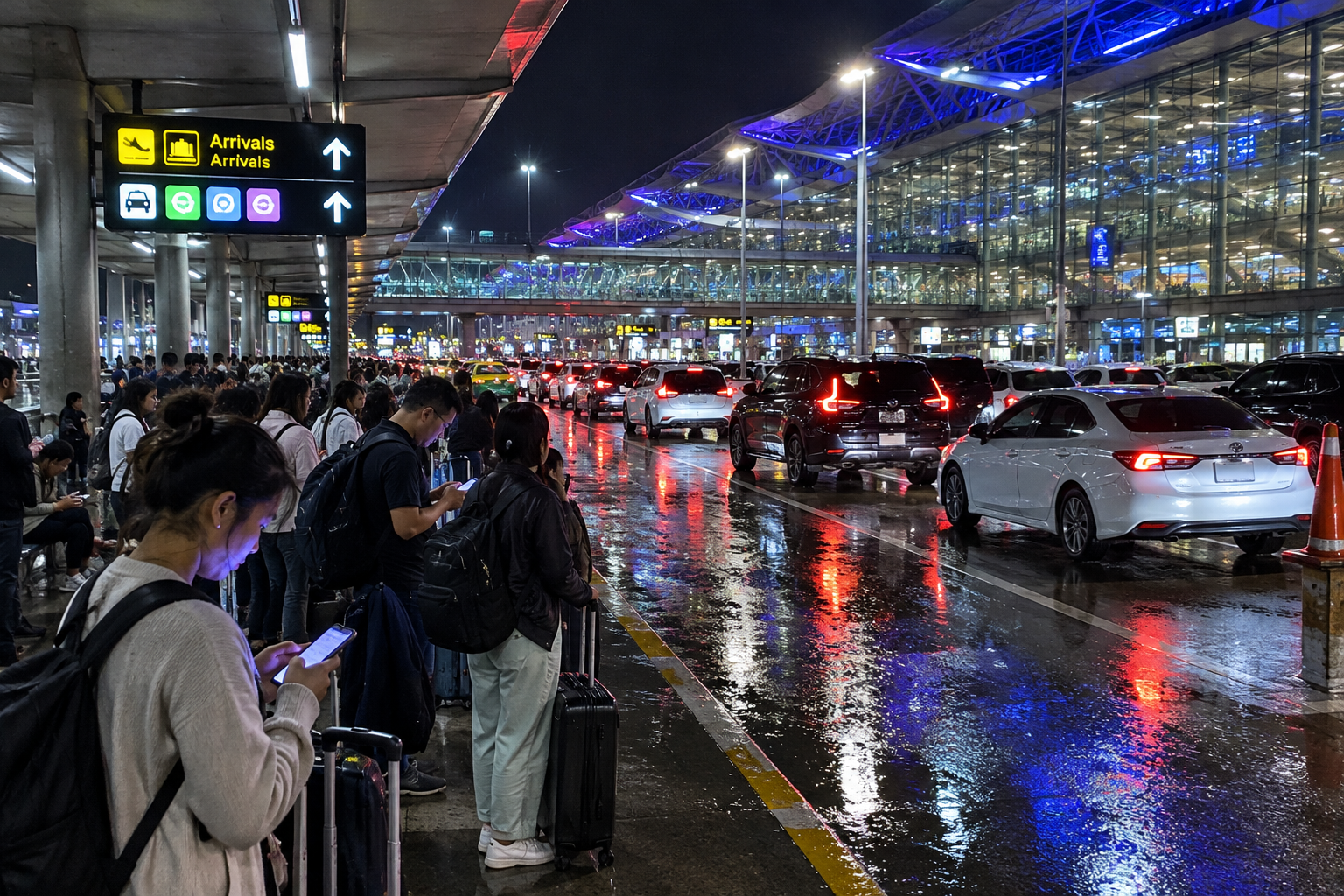
Late night arrivals in Bangkok often look simple on paper. You land, clear immigration, collect your bags, open a ride hailing app, and expect a car within minutes. In practice, the hours after midnight can be some of the hardest times to secure a smooth pickup from the city’s major airports.
For many travelers, the problem is not that ride hailing apps never work. It is that they become inconsistent exactly when people are tired, carrying luggage, unfamiliar with the airport layout, and under pressure to get to a hotel quickly. Understanding why this happens can help travelers set better expectations, avoid common mistakes, and choose smarter backup options.
What Changes at the Airport After Midnight
Bangkok’s two main commercial airports, Suvarnabhumi Airport and Don Mueang International Airport, are active late into the night. Even so, the operating environment changes significantly after midnight. Passenger flows become more uneven, public transport options shrink, airport staffing patterns shift, and the balance between ride demand and driver supply can become unstable.
During daytime hours, a ride hailing ecosystem benefits from volume and predictability. There are more drivers already on the road, more airport staff available to direct traffic, and more passengers arriving in steady waves. After midnight, those conditions weaken. A single delayed inbound flight can suddenly release hundreds of travelers into the pickup system at once. If several flights land close together, ride requests can spike sharply within a short window.
At the same time, fewer drivers may be willing to queue at airports or drive long pickup distances late at night. This creates a mismatch. The app may still show cars on the map, but the number of drivers willing to accept a specific airport job can be much lower than it appears.
Demand Surges When Flights Cluster Together
One major reason ride hailing apps feel unreliable after midnight is the timing of flight arrivals. Many international schedules are built around hub connections, slot availability, and airline operations rather than passenger convenience. As a result, a large number of flights can arrive in Bangkok during late evening and early morning windows.
When several flights land between midnight and 2:00 a.m., ride demand can surge all at once. This is not just a matter of more people opening the same app. It is also a matter of traveler behavior. Most late night arrivals want immediate transport. They are less likely to stop for food, less likely to linger, and more likely to request a car as soon as they regain mobile service.
That creates a compressed demand curve. In practical terms, the system goes from manageable to overloaded very quickly. A traveler may see long wait times, repeated driver cancellations, or a fare that changes by the minute. None of those outcomes necessarily means the app is broken. They often mean demand has temporarily exceeded the number of willing and available drivers.
Why flight delays make the problem worse
Air travel is inherently variable. A flight that was supposed to arrive at 11:15 p.m. may land at 12:05 a.m. Another that was scheduled for 12:10 a.m. may arrive early. When delays stack up, multiple passenger groups can enter the landside pickup area together.
Late night airport pickup systems are especially sensitive to this kind of bunching. Drivers who might have handled a steady stream of requests can get overwhelmed by a sudden wave. This is one reason why a ride hailing app may work perfectly on one night and poorly on the next, even at the same airport and the same hour.
Driver Supply Drops Late at Night
Apps depend on independent drivers making real time decisions. After midnight, many drivers simply log off. Some have already completed a full day of work. Others prefer to avoid airport congestion, long waits, or uncertain return trips. This matters because app reliability depends not only on how many registered drivers exist in the city, but on how many are active, nearby, and willing to accept your route right now.
Late night driving has tradeoffs. A driver may face fatigue, lower visibility, and fewer opportunities to pick up another fare after dropping a passenger at a distant hotel or residential neighborhood. If the destination is outside a profitable zone, the trip may be less appealing. Drivers may also weigh fuel costs, tolls, queue time, and the chance of getting stuck in airport pickup confusion.
From a traveler’s perspective, it can be frustrating to see multiple assigned drivers cancel. From the driver’s perspective, the request may not make economic or practical sense. Airport pickups often involve waiting, navigating designated zones, and coordinating with a passenger who may not yet be at the curb. After midnight, even small uncertainties can push a driver to decline or cancel.
Not every visible car is truly available
Maps inside ride hailing apps can create a false sense of supply. A car icon near the airport does not always mean that driver is free, willing, or eligible to take your ride. Some may be finishing another trip. Some may be outside the official pickup area. Some may be heading home. Others may reject airport jobs because of traffic controls or low expected earnings.
This gap between apparent supply and actual supply is one reason users often feel misled. The app interface suggests abundance, but the real market is much thinner.
Airport Pickup Rules Add Friction
Airports are controlled transport environments. Unlike a normal city street, pickup areas are regulated, segmented, and sometimes changed based on traffic conditions or airport policy. That structure can reduce chaos overall, but it can also make ride hailing pickups less intuitive, especially for first time visitors arriving after midnight.
Some airports designate specific zones for app based pickups. Others restrict where private cars can stop, how long they can wait, or which level passengers must use. If a traveler is standing in the wrong place, a driver may circle, call, or cancel. If the driver enters the wrong lane or misses the meeting point, the pickup can fail even when both sides are trying to connect.
These issues become more severe at night because wayfinding feels harder when you are tired, jet lagged, and carrying luggage. Signage that seems clear in daylight can feel confusing after a long international flight. A short delay in finding the correct exit can trigger a cancellation if the driver is under pressure to keep moving.
Terminal complexity matters
Large airports are not simple pickup environments. Multiple levels, domestic and international sections, taxi lanes, hotel shuttle points, and short term parking access can make coordination difficult. If the app’s pin location is vague or slightly misplaced, the driver and passenger may effectively be in different micro locations within the same terminal area.
This kind of mismatch is common in airports worldwide. Guidance from transportation authorities such as the Federal Highway Administration on airport ground access shows how curbside operations can become bottlenecks when multiple transport modes compete for limited space. After midnight, when staffing and traveler awareness may be lower, those bottlenecks can feel even more disruptive.
Connectivity Problems Can Break the Pickup Process
Reliable ride hailing depends on reliable connectivity. That sounds obvious, but airports create several points of failure. A traveler may land without an active local SIM, depend on airport WiFi, or struggle with roaming. Even a short interruption in mobile data can derail the process of confirming a ride, messaging a driver, or updating a pickup point.
After midnight, connectivity issues can have outsized effects because alternatives are fewer. During the day, you might step aside, reconnect, and try again while other transport options remain available. Late at night, a failed booking or missed call can mean starting over in a thinner market with longer waits.
Airport WiFi can also be inconsistent in practice. Login portals, signal handoffs, and crowded access points can create friction. If the app requires SMS verification, a traveler without functioning cellular service may not be able to complete account access. If the driver calls through the app and the call does not connect, the driver may assume the passenger is unreachable and cancel.
Battery drain is an underrated risk
Long haul travel drains phones quickly. Boarding passes, entertainment, messaging, photography, and roaming all consume power. By the time a traveler reaches the arrivals hall, battery life may be low. That matters because ride hailing is not a one tap transaction at an airport. You may need your phone for booking, live location, messages, calls, payment confirmation, and navigation to the correct pickup zone.
A low battery increases the chance of mistakes, rushed decisions, and communication failures. If the phone dies after a driver accepts the ride, the booking may collapse completely.
Driver Cancellations Are More Common Than Travelers Expect
One of the most frustrating late night airport experiences is the cycle of acceptance followed by cancellation. This often happens for structural reasons rather than random bad luck. Drivers may accept quickly to hold an opportunity, then reassess once they see the exact terminal, traffic conditions, toll route, or destination.
Some may discover that the pickup point is too congested to reach efficiently. Others may decide the destination is too far from areas where they can find a return fare. In some cases, the passenger’s delay in reaching the curb can lead the driver to give up and move on. Since airport pickup zones are tightly managed, drivers may not be able to wait long without risking enforcement or losing time.
Travelers often interpret cancellation as personal inconvenience caused by a single driver. In reality, repeated cancellations usually signal a market level problem: the trip is difficult to complete under current conditions.
Why destination matters
Not all late night airport rides are equally attractive. A trip to a central hotel district may be more appealing than a drop off in a distant suburb. Drivers consider the likelihood of finding another fare after drop off. If they expect an empty return, they may avoid the request. This is especially relevant after midnight, when spontaneous street demand is lower and some neighborhoods are quiet.
That means two passengers standing side by side at the same airport may have very different app experiences based on where they are going.
Pricing Volatility Can Make Availability Feel Worse
When users see prices jump sharply after midnight, they often conclude that the app is unreliable. Strictly speaking, high prices are not the same as no service, but in practical terms they can have a similar effect. If the fare rises beyond what a traveler is willing to pay, the app has failed to deliver a usable option.
Dynamic pricing reflects supply and demand. When too many people request rides and too few drivers accept them, prices rise to draw more drivers into the area. The theory is simple. The traveler experience is not. In an airport setting, dynamic pricing can feel arbitrary because the user has little visibility into the causes. You may refresh the app and see a significantly different fare a minute later without understanding whether the market is improving or deteriorating.
Late night pricing stress is also psychological. Travelers are tired and often comparing the app fare to what they expected before landing. A high quote can trigger repeated app checks, switching between services, or waiting in hopes of a drop. That delay can backfire if supply tightens further.
Local Regulations and Airport Operations Shape the User Experience
Ride hailing at airports is never governed by app design alone. It sits within a broader system of airport policy, local transport regulation, traffic management, and commercial arrangements. Even if a platform is technically available, operational limits can affect how smoothly pickups happen.
Airports must balance private cars, licensed taxis, buses, hotel shuttles, employee transport, and passenger safety. That often leads to designated lanes, access fees, staging areas, or restrictions on stopping time. If ride hailing vehicles do not have priority access, drivers may face delays that discourage them from accepting jobs.
Travelers can better understand this by looking at how airport ground transport systems are managed in general. Informational resources from airports and public agencies often explain that curbside space is finite and heavily controlled. For example, the overview of Bangkok airport transport options illustrates how many different modes compete to move arriving passengers efficiently.
These operational realities do not mean ride hailing is impossible. They mean it is one participant in a crowded transport ecosystem, and after midnight that ecosystem becomes less forgiving.
Tourists Face Extra Friction Compared With Local Users
Local residents often navigate late night airport pickups more easily than visitors. They may already know which level to use, which app works best for certain routes, how to contact drivers in Thai or simple English, and when it is smarter to switch to another transport mode. Tourists usually do not have that advantage.
Several factors make visitors more vulnerable to ride hailing problems after midnight:
- They may not know the official pickup zone.
- They may not have a local phone number.
- They may be unfamiliar with airport layout and signage.
- They may not know local traffic patterns or toll expectations.
- They may have trouble communicating exact location details.
- They may be carrying more luggage, children, or oversized items.
Each of these increases the chance of a failed match or cancellation. Even a simple message from a driver asking the passenger to move to a different gate can become a major obstacle if the traveler does not understand the instruction or cannot find the location quickly.
Language and messaging issues
Many ride pickups are saved by fast communication. A driver sends a short note, the passenger replies with a landmark, and the meeting point becomes clear. After midnight at an airport, that communication loop may break down. App translation is not always reliable, mobile data may be unstable, and travelers may be too exhausted to interpret directions accurately.
This is one reason why airport rides can fail even when both parties are acting in good faith. Coordination is harder than it looks.
Competing Transport Options Affect Driver Incentives
Another overlooked reason for late night unreliability is competition between transport channels. At Bangkok airports, drivers may compare app based pickups with other earning opportunities, including standard taxi queues, prearranged transfers, or city pickups outside the airport zone. If those alternatives offer faster turnover or less hassle, app demand at the airport may be underserved.
From the traveler’s side, this can feel irrational. If many passengers need rides, why would drivers not come? The answer is that gross demand does not automatically translate into attractive work. If airport access is slow, pickup coordination is messy, and return fares are uncertain, some drivers will choose other options.
In economic terms, the issue is not just demand quantity. It is trip quality from the driver’s perspective.
Weather, Events, and Overnight Conditions Can Tip the System
Late night airport reliability can deteriorate further when external conditions change. Rain is a major factor in Bangkok. A downpour increases road risk, slows traffic, and raises demand from passengers who might otherwise use another mode. If weather hits around the same time as multiple arrivals, app performance can collapse quickly.
Citywide events also matter. Concerts, nightlife peaks, holiday travel, and long weekends can reduce available drivers or shift them toward more profitable areas. Overnight roadworks and lane closures may further complicate airport access. Because these factors are temporary and uneven, travelers can have very different experiences on different dates even if their arrival time is similar.
Why unpredictability is part of the problem
People tend to accept inconvenience more easily when it is consistent. What makes late night ride hailing stressful is that outcomes are hard to predict. One passenger may get a car in six minutes. Another arriving thirty minutes later may wait forty minutes and face three cancellations. This variability undermines trust and makes the apps feel unreliable, even when they still function some of the time.
How Travelers Can Reduce the Risk of a Bad Pickup Experience
While no strategy can guarantee a perfect late night airport ride, several practical steps can improve the odds:
Prepare connectivity before landing
Set up roaming, an eSIM, or a local SIM plan in advance if possible. Screenshot your hotel address, booking details, and any terminal pickup instructions. Do not assume airport WiFi alone will be enough.
Charge your phone before arrival
Carry a power bank and cable in an easily accessible bag. A functioning phone is essential for booking, messaging, and navigation in the arrivals area.
Know the pickup zone before requesting
If possible, confirm the official ride hailing pickup point for your terminal before landing. Booking too early while still inside immigration or baggage claim can increase the chance of cancellation.
Stand exactly where the app indicates
Follow the pin and instructions precisely. Small location mismatches cause many late night cancellations.