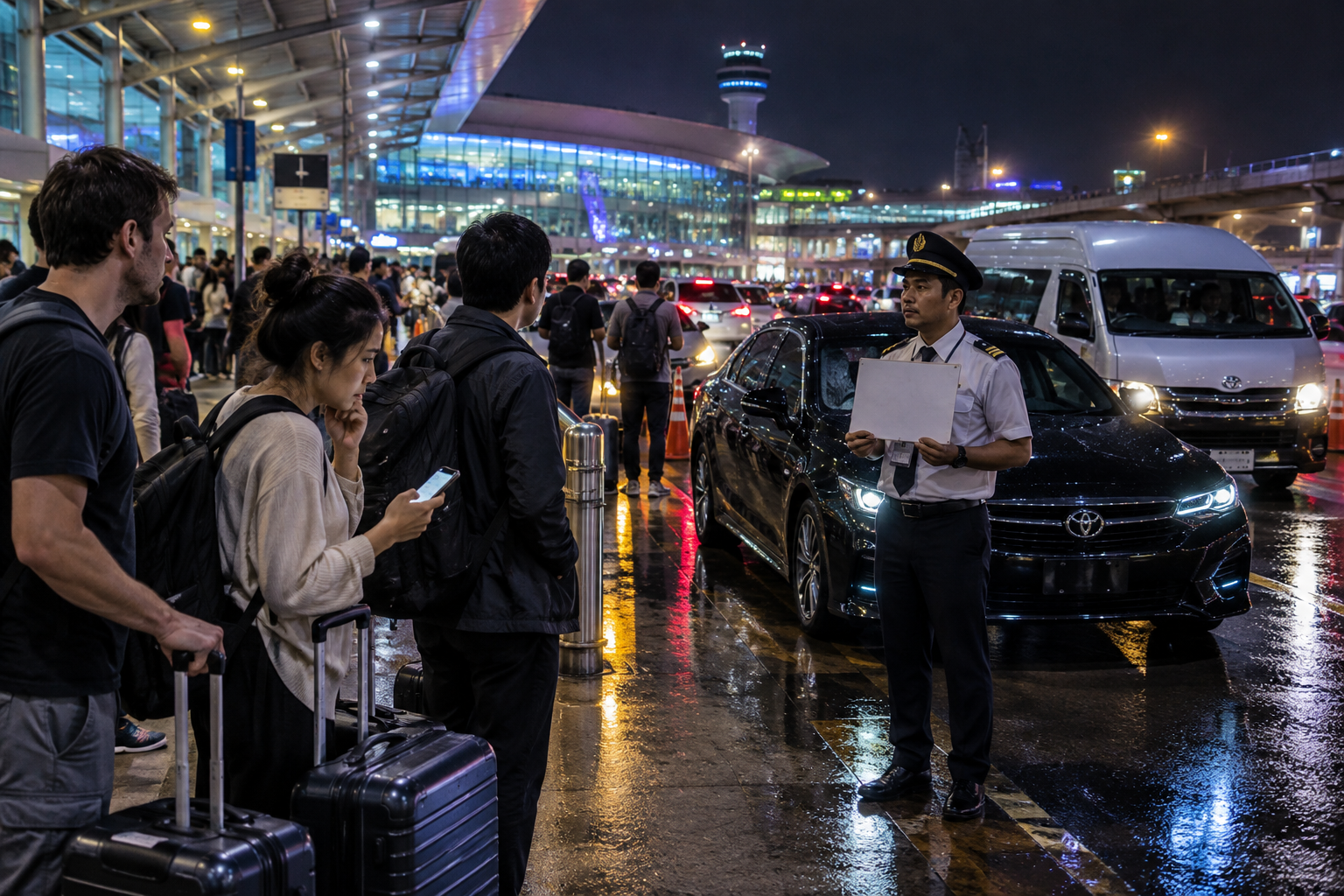
For many visitors landing in Bangkok, booking a ride through Bolt feels like the obvious next step. The app is familiar, the prices often look attractive, and the promise of a quick pickup after a long flight is hard to resist. In practice, though, airport pickups in Bangkok can be much less predictable than many travelers expect.
The issue is not that Bolt never works. It is that airports create a special set of constraints that can turn an easy city ride into a confusing, delayed, or canceled pickup. If you are arriving at Suvarnabhumi or Don Mueang and want a smooth transfer, it helps to understand why app-based rides can become unreliable there and what alternatives usually work better.
How airport conditions change the ride-hailing experience
Using a ride-hailing app in central Bangkok is one thing. Using it at a major airport is another. Airports are tightly controlled transport environments with designated pickup zones, security rules, heavy traffic management, and constant passenger turnover. Those conditions affect driver behavior, waiting times, and even whether a driver wants to accept your trip at all.
Bangkok's two main airports, Suvarnabhumi Airport and Don Mueang International Airport, handle huge volumes of domestic and international travelers. At peak times, thousands of people may be trying to leave within a short window. That pressure creates friction for any app-based service that depends on independent drivers making quick decisions about whether the fare is worth the effort.
Unlike a standard curbside pickup at a mall or hotel, airport pickups often involve:
- Restricted pickup points
- Terminal congestion
- Parking or access fees
- Long walks to meeting areas
- Communication barriers between drivers and newly arrived travelers
- Driver uncertainty about traffic leaving the airport
- Passengers who are delayed by immigration, baggage claim, or customs
Each of these factors can reduce the reliability of a Bolt pickup even if the app itself appears to be functioning normally.
Why Bolt can feel unpredictable at Bangkok airports
Drivers may hesitate to accept airport jobs
At airports, drivers often have to weigh more than the displayed fare. They may consider how long it will take to reach the pickup point, whether they will get stuck in airport traffic, and whether the trip destination is profitable enough to justify the effort. A short ride from the airport to a nearby hotel may look convenient to a passenger, but a driver may see it as low value if airport access takes too much time.
This can lead to several common outcomes. A booking may sit unassigned longer than expected. A driver may accept the ride and then cancel after realizing the pickup location is inconvenient. In some cases, the driver may call or message to confirm the destination before deciding whether to continue.
Airport pickup rules can be confusing
Even when ride-hailing is permitted, the exact pickup procedure may not be obvious. Airports often designate specific areas for app-based rides, and these can differ by terminal, level, or arrival gate. If the passenger is waiting in the wrong place, the driver may struggle to reach them or may refuse to circle around again.
For tired travelers, this is a real problem. After a flight, many people open the app before they fully understand where they are supposed to stand. The app pin may not match the practical pickup point. The driver may be somewhere nearby but unable to stop where the passenger expects. That mismatch creates frustration and increases the chance of cancellation.
Arrival delays break the timing of the booking
Airport arrivals are rarely perfectly timed. Immigration lines can be short one day and extremely long the next. Checked baggage may arrive quickly or take half an hour. Customs screening can add another delay. If a passenger books too early, the driver may arrive before the traveler is ready. If the passenger books too late, demand may spike and available cars may disappear.
This timing issue is especially important for international arrivals. According to the Tourism Authority of Thailand travel planning guidance, travelers should expect standard arrival formalities and prepare accordingly. In practice, that means transport decisions should account for uncertainty after landing, not just flight arrival time.
Communication can be difficult in the pickup phase
Many Bolt rides go smoothly with minimal communication, but airport pickups often require more coordination. Drivers may call to ask which exit you are using, what pillar number you are near, or whether you can move to a different level. If you do not have a local SIM, eSIM, airport Wi-Fi connection, or confidence making calls in Thailand, the process can break down quickly.
Even messaging inside the app may not solve the issue if the driver uses short local references that a visitor does not understand. Something as simple as not knowing whether you are on arrivals level or departures level can turn a routine pickup into a 15 minute confusion loop.
Traffic patterns around the airports are inconsistent
Bangkok traffic is famous for being unpredictable, and airport access roads are no exception. A driver who accepts your ride may suddenly realize that reaching the terminal curb will take much longer than expected. This can trigger cancellations, delays, or requests for the passenger to walk to a different location.
Weather makes this worse. Heavy rain can slow airport traffic dramatically and increase demand for app-based rides at the same time. Late evening arrivals after a storm or during a holiday period can be especially difficult.
Surge patterns and low apparent fares distort expectations
One reason travelers like Bolt is pricing. Sometimes the app shows fares that are lower than what a metered airport taxi might cost. But a low displayed fare does not always produce a dependable pickup. If the price is not attractive to drivers given airport conditions, you may spend valuable time waiting for a ride that never materializes.
This is one of the main reasons Bolt can feel unreliable at Bangkok airports. The app may suggest that a car is available, but driver incentives at that moment may not align with what the passenger sees on screen.
The specific challenges at Suvarnabhumi Airport
Suvarnabhumi is Bangkok's primary international gateway, and it is large, busy, and often overwhelming for first-time visitors. The airport is modern and well connected, but that does not automatically make app pickups easy.
Scale and layout create confusion
The airport's size means that simply getting from baggage claim to the correct pickup area can take longer than expected. Travelers who are unfamiliar with the terminal may follow signs for public taxis, rail, or bus services and then realize too late that their app driver is waiting elsewhere. If the app pickup point is not intuitive, the chance of a missed connection goes up.
Driver circulation can be slow
Even when a driver is nearby, airport road systems and lane controls can make circulation slow. A driver who misses the correct lane or arrives while the passenger is still walking may need several extra minutes to loop back. Some drivers will do that. Others will cancel and move on to an easier job.
Short destination trips are often less appealing
If you are staying near the airport or in eastern Bangkok, your trip may be relatively short. That can make your booking less attractive compared with a longer city-bound fare. While not every driver thinks this way, enough do that travelers should be aware of the pattern.
The specific challenges at Don Mueang Airport
Don Mueang handles many domestic flights and low-cost carriers, which means high passenger volume, frequent turnover, and lots of travelers looking for budget-friendly ground transport. That environment can produce its own form of unpredictability.
Curbside activity is intense
The terminal frontage can become crowded quickly, especially during busy domestic arrival periods. Meeting a driver in a fast-moving curb environment is harder than many travelers expect. If you are carrying luggage, traveling with children, or arriving during rain, moving to an alternate pickup point may not be practical.
Drivers may prefer easier urban pickups
At certain times of day, a driver working in the city may prefer local trips over an airport run that involves congestion and uncertain waiting time. This can reduce the pool of willing drivers, even if the app still looks active.
Common traveler mistakes that make Bolt airport pickups worse
Not every bad pickup is the driver's fault or the app's fault. Some problems happen because travelers unknowingly create complications for themselves.
Booking before clearing the airport
One of the most common mistakes is requesting a car too early. If you have not yet passed immigration, collected luggage, and reached the correct public pickup area, you are guessing about timing. That guess is often wrong.
Standing in the wrong location
Passengers sometimes wait at the first curb they see, assuming the driver can stop there. Airports usually do not work that way. If your driver says they are at Gate 4, Door 8, or a designated ride-hailing zone, you need to verify that you are actually there.
Ignoring driver messages
If your phone is not connected or you are not checking the app, you can miss important instructions. A driver may be trying to save the pickup by telling you exactly where to go. Silence often leads to cancellation.
Assuming low price equals best option
Budget matters, but airport arrivals are one of the worst times to optimize only for the cheapest fare. After a long flight, the value of a reliable, clear, legal, and easy transfer is often much higher than the value of saving a small amount.
What travelers should do instead for a more reliable airport transfer
If your priority is reliability rather than squeezing out the absolute lowest fare, there are better approaches than depending solely on Bolt at Bangkok airports.
Use the official public taxi system when simplicity matters most
For many travelers, the official airport taxi queue is the most practical choice. It is built specifically for arriving passengers, it is easy to find, and it reduces the coordination problems that app pickups often create. You join the queue, receive the assigned taxi, and leave without having to negotiate terminal pickup logistics with an individual driver.
This option is especially sensible if:
- You are arriving late at night
- You have large luggage
- You are traveling with family
- You do not have mobile data yet
- You are visiting Bangkok for the first time
- You want the least confusing exit from the airport
Travelers should still expect tolls and airport-related charges where applicable, but the process is generally straightforward compared with arranging an app-based pickup in a congested arrivals environment.
Pre-book a hotel transfer if convenience is your top priority
If you want the smoothest possible arrival, especially after a long-haul international flight, a pre-arranged hotel car or private airport transfer can be worth the extra cost. The biggest benefit is certainty. Someone is expecting you, the pickup instructions are usually clear, and there is less risk of last-minute cancellation.
This is often the best strategy for:
- Business travelers on a schedule
- Families with young children
- Travelers arriving after midnight
- Visitors with mobility concerns
- People carrying valuable equipment or multiple bags
Take the Airport Rail Link or other public transport when appropriate
If you are comfortable navigating Bangkok and traveling light, rail can be the most predictable option from Suvarnabhumi. It avoids road traffic and removes the uncertainty of waiting for a willing driver. From there, you can connect to the BTS Skytrain, MRT, or take a short taxi ride from a city station closer to your hotel.
For travelers who want to understand the broader urban transport network, the overview of Bangkok transportation gives useful context on how rail and road systems fit together in the city. That context matters because the best airport strategy is often a mixed approach rather than a single door-to-door car ride.
Public transport is not ideal for everyone, but it can be excellent if:
- You arrive during heavy road traffic
- Your hotel is near a rail line
- You have only carry-on luggage
- You are comfortable with transfers
Move away from the airport before booking a ride-hailing car
One of the smartest workarounds is to avoid booking Bolt directly from the airport. Instead, take the rail link or another official transport option a short distance into the city, then request a ride from a normal urban location. Once you are away from airport restrictions and congestion, app-based pickups are often much smoother.
This approach can reduce:
- Driver hesitation
- Pickup confusion
- Airport access complications
- Cancellation risk tied to terminal traffic
It is not the best option if you are exhausted or carrying heavy bags, but for solo travelers and experienced visitors it can be very effective.
How to decide which airport exit strategy is best for you
There is no single perfect option for every traveler. The right choice depends on your arrival time, budget, confidence level, luggage, and destination.
Choose official airport taxi if you want the easiest all-around option
This is the default recommendation for most first-time visitors. It is usually the best balance of convenience, clarity, and speed.
Choose pre-booked transfer if you want certainty
If you do not want to think about transport after landing, this is usually the least stressful option.
Choose rail if you want predictability and low traffic exposure
This works best for light packers and travelers staying near rail-connected areas.
Choose Bolt only if conditions are favorable
Bolt can still make sense if you know the airport pickup rules, have working mobile data, are not in a rush, and are prepared for some uncertainty. It is often better as a secondary option than as your only airport plan.
Practical tips if you still want to try Bolt at a Bangkok airport
If you decide to use Bolt anyway, a few habits can improve your odds of success.
Wait until you are fully ready
Do not request a ride until you have your luggage, have cleared customs if applicable, and are standing at or very near the designated pickup area.
Confirm your exact location
Check signs carefully. Know the terminal, floor, gate, door number, and any nearby marker. If the driver contacts you, reply with precise details.
Have mobile connectivity before you book
Airport Wi-Fi can work, but a local SIM or eSIM is more dependable for calls and messages during pickup coordination.
Be realistic about cancellation risk
If one driver cancels, decide quickly whether it is worth trying again or whether you should switch to the official taxi queue. Do not sink 30 to 40 minutes into repeated failed attempts just to save a little money.
Avoid booking during obvious surge moments if you have alternatives
Major arrival waves, storms, and late-night peaks are poor times to rely on an app that depends on individual driver willingness.
Why this matters for the broader question of whether Bolt is reliable in Thailand
When travelers ask whether Bolt is reliable in Thailand, the answer depends heavily on context. In many city neighborhoods, Bolt may work perfectly well for everyday trips. Airports are different. They magnify every weak point in the ride-hailing process: driver incentives, pickup restrictions, communication gaps, and timing uncertainty.
That is why reviews and traveler experiences can sound contradictory. One person lands at a quiet time, finds the right pickup zone, gets a willing driver, and has a smooth ride. Another lands during a busy period, cannot contact the driver, gets canceled twice, and concludes that Bolt is unreliable. Both experiences can be true.
The key insight is that airport reliability is not only about the app itself. It is about the interaction between the app, the airport environment, and the traveler's preparation. Understanding that interaction is the best way to avoid stress and start your Bangkok trip on the right foot.